See What Crew Strain Is Costing You, and Act Before It Hits the Programme.
Stop guessing from a once-a-year survey. See the exact driver stretching your crews weeks before it becomes rework or a walk-off, act on it, and hold the dated record, the only weekly loop that proves what you did.
- ✓Locked daily brief by 07:30
- ✓One change channel, logged
- ✓Protected cover for breaks
- Daily brief · Demands✓
- Change channel · Control✓
- Break cover · Recovery✓
One named champion, one 30-minute setup call, and a QR at the welfare cabin. That is the whole ask.
The same weekly loop, in their words.
From EEmber’s first deployments in further education. The loop is identical on site, a 60-second check-in, a named driver, an owned action, a dated record.
“EEmber gave us a simple weekly way to spot early pressure signals and act on them. It moved us from assumptions to clear decisions, daily stabilisers and visible changes, without becoming a tick-box wellbeing exercise. The main benefit was greater stability. It showed where change and workload pressures were building, and its daily controls helped protect ‘winnable days’ for staff.”

“I found the controls were simple and effective and did not add further stress to my days. The pilot helped me to spot operational drift early and put simple controls in place so days were easier to navigate, especially when tasks pile on top of each other unexpectedly.”

Crew strain does not stay a wellbeing problem. It turns into rework, incidents and walk-offs.
By the time strain shows up in your lagging data, it has usually already cost you somewhere else first. A tired, stretched crew makes more errors, misses more hazards, and is quicker to leave. None of it lands on the wellbeing line. It lands on the programme and the margin.
A policy is not management. Intent is not evidence.
Two things changed in the last year. Together they turn crew strain from an HR topic into a governance exposure with the director’s name on it.
The HSE is enforcing on stress
Enforcement on work-related stress has stepped up, and the HSE is now treating psychosocial risk alongside physical safety in routine inspection. A written policy on its own is not management, and inspectors are asked to evidence impact, not intent.
The director carries it personally
Where a breach is down to a director’s consent, connivance or neglect, that director can be prosecuted personally, not only the company. The duty covers mental health, so far as is reasonably practicable.
The standard now expects the evidence
ISO 45003:2021 sets the international bar for managing psychosocial risk, identify the hazard, act, document, review. Leading indicators and a dated trail are now what “managed” is expected to look like.
Not another survey that scores the problem. The weekly loop that names the driver and proves you acted.
Everything else tells you how a crew felt months ago, or holds a policy on a shelf. Only one corner sees the driver early and leaves the dated proof behind.
| EEmber | Annual staff survey | Policy + EAP | Doing nothing | |
|---|---|---|---|---|
| A leading read (sees it building) | ✓ | ✗ | ✗ | ✗ |
| Names the specific driver | ✓ | Score only | ✗ | ✗ |
| Picks the control, sized to the band | ✓ | ✗ | Generic | ✗ |
| A proportionate action, owned and dated | ✓ | ✗ | Static | ✗ |
| Dated proof you acted, mapped to ISO 45003 | ✓ | ✗ | On paper | ✗ |
| Effort on you | One setup call | Admin every round | Sits on a shelf | None, until it is too late |
None of that is worth a thing if the lads won’t use it.
Every site has a graveyard of apps nobody opened, and men in this industry have been asked about their mental health before and said they were fine. Here is why this one gets answered.
- No app, no download, no login. A QR code at the welfare cabin, a browser, sixty seconds, gone.
- Most of it is about the job, not the man. Demands, control, support, relationships, role and change — the six HSE Management Standards. The what, not the who.
- Nothing comes back to the individual. No name, no account, no gang under seven ever reported.
See what EEmber sees.
On most sites, the first you hear that a good operative was struggling is when the notice lands. Not a failure of anyone’s management, a function of how sites run. EEmber reads strain at crew level, never the individual. The fastest way to understand it is to feel it yourself.
Thirteen or fourteen questions. Three strain markers drawn from an established burnout inventory, one on whether the work feels worth it, your mood, what is driving the pressure, and six working conditions mapped to the HSE Management Standards. Nothing is stored, it runs in your browser.
Scoring the strain markers…
Never your answers. The crew picture, and what to do about it.
Illustrative, not your real crew data.
A one-person read is indicative only. Strain items drawn from the Copenhagen Burnout Inventory. The private card demonstrates what an operative would receive; the live product is a crew signal.
You’re managing squad availability
A Premier League club runs a sports science department to monitor load across 25 athletes, so it doesn’t lose one to an injury it could see building. You have two hundred people doing harder physical work in worse conditions, and monitor none of it.
The six standards are load monitoring
Demands is training load. Control is how much say you have in how you work. Support is the backroom staff. Relationships is the dressing room. Role is knowing your position in the side. Change is a late change to the game plan. Not one of those is a conversation about feelings, and every one is a conversation a site manager already knows how to have.
Performance is a register men answer in
Ask a bricklayer to rate his wellbeing and he’ll tell you he’s fine. Ask him whether the face was ready at 07:30 and he’ll tell you the truth, at length. Same information, and only one version gets answered honestly.
You find out which crew is in trouble weeks before it reaches the programme.
Not a dashboard you log into. The page that lands on your desk on Monday, built for you, every week.
- Every crew, every week, on one page. Not a site average that hides the one crew in trouble inside four that are fine.
- Pressure is the cause. Burnout is the effect. The six HSE Management Standards tell you which condition is doing the damage. The burnout read tells you how much has already accumulated. Read together, they tell you whether you are early or late.
- The trend is the signal, not the week. Two periods side by side separates a crew that is sliding from a crew that had a bad week.
Which crew, and what is driving it
Every crew scored against the six HSE Management Standards. All data aggregated, gangs under 7 hidden.
You are handed the exact control to run, with a name and a date on it.
A survey vendor hands you a number and leaves. A consultant hands you a report and leaves. We are still in the room when the action runs.
- The driver decides the control, not the score. In one deployment leadership assumed workload. The read showed control. More labour would have moved nothing.
- The band sets how much runs. Green gets one control. Yellow gets three. Orange gets five, with protections alongside. Red stops being a control at all and becomes a same-day reset. The engine never hands a site manager a fix they cannot authorise.
- Ranked on what held. Every control that runs is logged against whether the score held four weeks later, and that record orders the next recommendation. Operational changes only, never awareness days.
- It lands as a tracker, not a recommendation. Three controls, a named owner each, a box to tick and a line for where the proof lives. A tick on its own is a claim; a tick with “in the Friday site brief” beside it is evidence.
Next week, to fill in
Tick each control on the day you run it. Note where the proof is. That is the whole job.
| Control | Owner | M | T | W | T | F |
|---|---|---|---|---|---|---|
| Locked daily brief by 07:30One brief, one channel. No side-radio task changes. HSE Demands · ISO 45003 8.1.2 |
Site Manager | |||||
| Where is the proof | ||||||
| One change channel, loggedWritten reason attached to every sequence change. HSE Control · ISO 45003 5.4 |
Foreman | |||||
| Where is the proof | ||||||
| Protected cover for breaksNamed cover operative, face never fully stood down. HSE Breaks & pace · ISO 45003 6.1.4 |
Foreman | |||||
| Where is the proof | ||||||
The fixes that cost money stop dying in a corridor.
Some controls a foreman can run on Monday. Others need a budget line or a decision nobody on site is allowed to make. Those are the ones that quietly disappear.
- Raised, costed, and given a decision owner. Not an action with a tick box. A decision with a name, a number, and a date it has to be answered by.
- Deferred is a recorded outcome, not a dead end. The item comes back, and the register counts how many times, and who.
- Under HSWA s.37 it changes your position. “Nobody raised it” and “raised, costed, deferred three times by a named director” are not the same defence.
Open decisions above site authority
Raised off the weekly read. Every item has a cost, an owner and a date it must be answered by.
You can show a Tier 1, the HSE or a tribunal what you did, not what you meant to do.
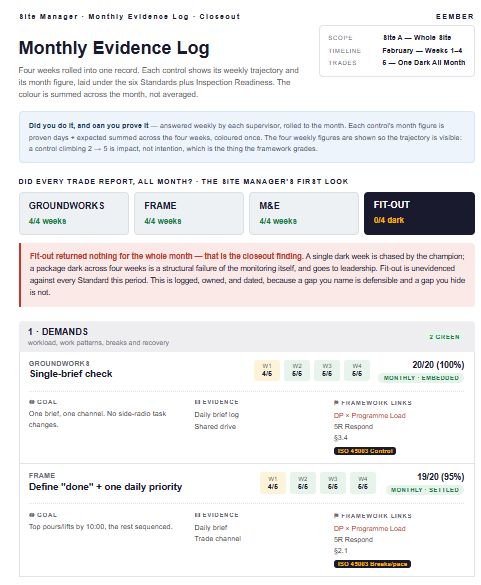
You do not reach for a policy and hope. You open one page and show what you saw, what you did, who owned it and what changed.
- Scored against HSE standards, tagged to ISO 45003 clauses. One record, in whichever language the person asking uses.
- It goes further than a toolbox talk register. An attendance sheet proves people were in a room. This proves a risk was identified, a control chosen, a named person ran it, and someone independent confirmed it.
- It tells you whether the control worked, so you can run it again. Four weeks on, the crew is re-read. What held becomes the thing you reach for next time the same driver fires on another crew. A partial result reopens the item rather than closing it quietly. The log is not just a defence, it is how the site gets better at this.
Every Green you show anyone has been checked by a person before it got there.
Most systems let a tick mark stand as done. EEmber will not. The board never shows Green until the champion has verified the proof is real. Every seat sees its own view of the same verified record.
A control on paper isn’t reasonable-steps. The dated proof it ran is.
Two struggling teams. One deployment. The needle actually moved.
EEmber’s first deployments ran in further education; the loop is identical on site. Two teams sat in a Yellow and Orange mix, the kind of sustained pressure that becomes absence, turnover and incidents on site if nothing changes.
The questions H&S directors ask first.
Reading the numbers
What exactly are you measuring?
Two things, deliberately kept apart. Pressure is scored against the six HSE Management Standards — demands, control, support, relationships, role and change — and tells you which working condition is doing the damage. Burnout risk is scored on the three Copenhagen Burnout Inventory dimensions and tells you how much strain has already built up in a crew. Cause and effect, on the same crews, in the same weekly pack.
Why not just one score?
Because on their own each one misleads you. A crew can be under heavy pressure with no accumulated strain yet — that is the cheapest moment to act, and a burnout-only read would show you nothing. A crew can also be carrying real strain from a phase that has already finished, where the pressure read is now clean and the fix is recovery, not re-sequencing. Read together they tell you whether you are early or late, which is the decision you are actually making.
On site
How does anonymous check-in work on site? Not everyone has a smartphone.
Check-in works on a phone, tablet, desktop, or a printed QR code at the welfare cabin, canteen or gate. It opens in a browser, no app, under 60 seconds. No manager ever sees one person’s answers. EEmber reads broken conditions across a crew, not people, and aggregates so small crews cannot be identified. Data is UK-hosted under UK GDPR, with a data processing agreement signed before anything is collected.
Won’t the lads just ignore it, or game it?
The ask is deliberately small enough that ignoring it costs more attention than doing it. On gaming: the score is read as a trend across a crew, not a single week, so an individual pushing one direction moves very little. What matters far more is participation, and if a crew goes quiet the champion marks it dark rather than reading the silence as good news. A silent crew is a signal in its own right.
EEmber AI
What is EEmber AI actually doing?
Two jobs. It reads the weekly check-in data to identify which driver is doing the damage on a given crew, and it selects a proportionate control for that driver at that band from the action library. The library is not generic content — it is built from controls that have actually run on deployments, each logged against whether the crew score held at the four-week re-read. That outcome record is what orders the ranking.
Is it making decisions about people?
No, and it structurally cannot. The engine never sees an individual. It reads aggregated crew-level data, names a condition, and recommends an operational change to how the work is organised. It does not profile anyone, does not flag individuals to managers, and is not a clinical tool — it is an operational decision-support index, not a diagnosis.
Governance and fit
We already run Assure / Intelex / an HSEQ system. Does EEmber replace it?
No. Those tools handle incidents, permits and audits. None of them makes a weekly psychosocial-risk read with named drivers, written actions and owners. EEmber sits alongside your HSEQ system and makes the evidence it cannot — an operational layer on top of your existing policy, not a replacement.
Does this make us compliant?
No, and anyone telling you a piece of software does is selling you something. EEmber supports a timestamped, audit-ready evidence record and reasonable-steps evidence. Whether that is sufficient depends on what you do with it — the record shows the actions you chose to run, and the actions are yours. What we guarantee is the quality of the record, never a change in the score.
Run the whole loop free for a month. Keep it only if it works.
Your Free Crew Strain Snapshot
Run the instrument on your own site. See the loop name a driver and hand you a control, on a real tracker and log, scoped to you.
- A short exposure read: where your proof would stand if the HSE asked tomorrow
- A 7-question self-assessment against the ISO 45003 conditions
- A self-demo check-in shown on the real tracker and evidence log
Your First Month, Free
The full loop, run for you on one site you choose. Four weekly Site Welfare Reports, the evidence log built, the decision register live, at no cost for the first month.
- Daily anonymous check-ins via QR at the welfare cabin
- Four weekly Site Welfare Reports with named owners and dated actions
- Controls selected by EEmber AI, sized to the band, verified before they are logged
- Timestamped evidence log, mapped to ISO 45003, retrievable on demand
- Board-ready pack at the end of the month
Priced per site, not per head
| Under 20 operatives on site | Not for us |
| 20 to 60 operatives | £3,000/mo |
| 61 to 125 operatives | £3,750/mo |
| 126 to 250 operatives | £4,500/mo |
Founding Partner rate
Held for as long as you stay, including as the estate grows. We are early, and we would rather have the sites and the evidence than the margin. The rate closes when the founding cohort does.
Counting rules, so there are no surprises on the call: subcontract operatives count, because they are in the read either way. A site with under six months left to run does not count and should not be in scope. A site that is more than half subcontract carries £500 a month on top, and we will tell you why.
One honest note. If you want another poster for the welfare cabin, EEmber is not it, and we will tell you so on the call. If you want the log that stands up when a Tier 1, the HSE or a tribunal asks what you did, this is exactly it. Cancel any time; the evidence you have built stays yours.
The question is coming. Be the contractor holding the file.
You have done the awareness day and the survey and still could not show which crew was about to break, or prove you acted. Enforcement on work-related stress is live, and whether a claim or a Tier 1 audit lands is outside your control. The gap is not the policy. It is the proof.
There is a version of next year where the operative you would have lost is still on the job, the rework never happened, and you can say exactly why. That is the whole of it. Not a dashboard, not a wellbeing programme. The difference between finding out at the exit interview and knowing in week three, and being the contractor holding the file when the question comes.