When It’s Tested, Show What You Did to Stay Sighted, Don’t Argue It.
You have a policy and a survey, and nothing in between. EEmber turns a 60-second staff check-in into a weekly read on the conditions your people work under, a fix with a named owner, and a dated reasonable-steps trail that protects the senior manager personally, ready before 1 September 2026.
- ✓Caseload cap & reallocation
- ✓One logged escalation channel
- ✓Protected review blocks
- Caseload cap · Demands✓
- Escalation channel · Support✓
- Review blocks · Control✓
The same weekly loop, in their words.
From EEmber’s first deployments in further education. The loop is identical in a regulated firm, a 60-second check-in, a named driver, an owned action, a dated record.
“EEmber gave us a simple weekly way to spot early pressure signals and act on them. It moved us from assumptions to clear decisions, daily stabilisers and visible changes, without becoming a tick-box wellbeing exercise. The main benefit was greater stability. It showed where change and workload pressures were building, and its daily controls helped protect ‘winnable days’ for staff.”

“I found the controls were simple and effective and did not add further stress to my days. The pilot helped me to spot operational drift early and put simple controls in place so days were easier to navigate, especially when tasks pile on top of each other unexpectedly.”

A policy on the intranet is not sight of your culture. When it’s tested, the gap is personal.
The annual survey tells you a number about last year. It never tells you what you did about it, or when. In a regulated firm that gap does not sit on the company, it sits on a named senior manager, and it is live now.
A policy on the intranet is not oversight. The FCA has said it will look behind the wording.
Three deadlines turn conduct and stress risk from an HR topic into a personal-liability exposure with a named senior manager attached.
The non-financial misconduct rule lands
COCON 1.1.7FR brings bullying, harassment and violence into conduct-rule scope for around 37,000 non-bank firms. The FCA has rejected a tick-box approach and will look behind your policies at what happens on the ground. A dignity-at-work policy on its own is no longer the answer.
It is personal now
Under the Duty of Responsibility (FSMA s.66A) and Senior Manager Conduct Rule 2, a named senior manager is personally accountable for reasonable steps in their area. In 2023 the PRA fined TSB’s former CIO over £80,000 for failing to take them.
Payouts become uncapped
The Employment Rights Act removes the limit on unfair-dismissal payouts. Work-related stress can count as a disability with no formal diagnosis. One prevented senior exit is a five-to-six-figure event; an uncapped claim has no ceiling at all.
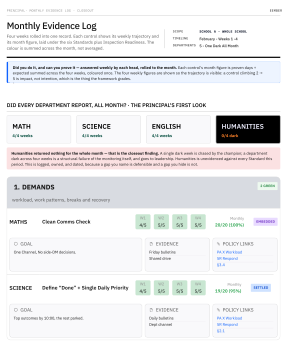
The survey told you morale was fine. It never told you what you did about it, or when.
A policy signed at onboarding, a survey once a year, a score that lands and connects to nothing. When a grievance or a resignation surfaces the gap, your reasonable-steps answer is a folder, not a live record. A policy is not sight of your culture. When it’s tested, the dated proof you acted is.
- A number from last year, months stale before it is read
- No driver named, so nobody acts on the real condition
- No owner, no dated action, nothing between policy and incident
- When it’s tested, the answer is “nobody told me”, not a record
- A leading read, every week, on the conditions per team
- The exact driver named: demands, control, support, relationships, role
- A proportionate step with a named owner and a date
- Every signal recorded next to the action taken, timestamped
You stop finding out from the grievance.
The desk quietly running too hot, you see the conditions building weeks before they become a complaint or a senior exit, while there is still time to act and to be seen acting. No more relying on nobody having told you, when the duty to have known is yours personally.
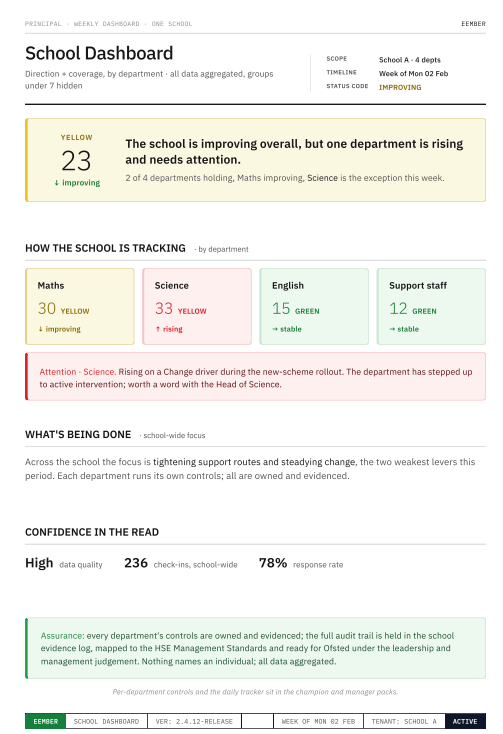
The record is a defence, not a weapon.
The fear is that documenting known pressure hands a claimant proof you knew. EEmber is built so that a signal is never recorded on its own, it is always logged next to the proportionate action, the named owner and the date. That is the exact shape of a reasonable-steps defence: not “we spotted a risk and sat on it”, but “we saw it, we acted, and here is when”. Invite your own counsel to read it, that is what it is built for.
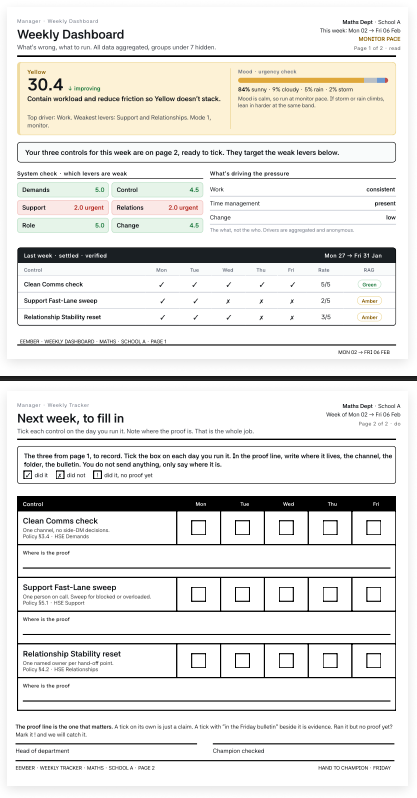
When it’s tested, you show what you did, not what you meant to.
When the FCA, your board or a tribunal asks what you did to stay sighted, you do not reach for a policy and hope. You open one page and show what you saw, what you did, who owned it and when, dated, mapped to the standard, exportable in under fifteen minutes. You become the senior manager who was visibly watching, not the one relying on nobody having told them.
Your compliance team builds nothing.
This is a managed loop we run, not a tool you operate. We run the check-ins, model the score, name the driver, assign the owners, chase completion and build the record. Your entire lift is one 45-minute setup call. You review one board-and-regulator-ready page; we run everything behind it, and it never becomes another thing on your plate.
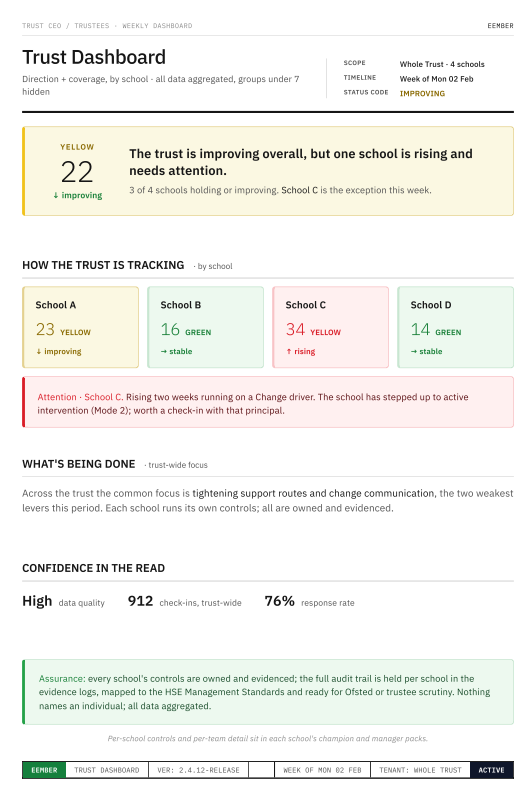
You can stand behind every Green, because a control on paper counts as zero.
Most systems let a tick mark stand as done. EEmber will not. A control on paper is not reasonable-steps; the dated proof it ran is. The board never shows Green until that proof exists, and the champion verifies the proof is real before anything reaches the log. So the Green you take to your board, or the FCA, is earned, not claimed.
A control on paper isn’t reasonable-steps. The dated proof it ran is.
And the same dated record answers every audience the senior manager is defended in front of. In a firm this size the SMF is the buyer, the owner and the liable person at once, one doorway, not three, so the one verified trail is read three ways: the regulator register, the board register, the staff register. The proof is verified before it reaches you, so you present it, you don’t assemble it.
Four steps to a dated record. You review one page; we run the other three.
No black box, no analysis on your side. Watch a 60-second check-in become a retrievable record you can put in front of the FCA, your board or a tribunal.
- ✓Locked daily brief by 08:30
- ✓One change channel, logged
- ✓Protected cover for breaks
- Caseload cap · Demands✓
- Escalation channel · Support✓
- Review blocks · Control✓
And when a daily fix is not enough, the same driver recurring for a month escalates to a logged decision, with an owner and a review date, while every action is benchmarked against a 4-week baseline. So your best defence is never “we fixed everything”, it’s a dated record showing you saw a structural problem you couldn’t fix alone, raised it, and named an owner. The chronic issues can’t quietly slip; they’re logged and escalated, which is exactly what reasonable steps looks like.
Two struggling teams. One deployment. The needle actually moved.
EEmber’s first deployments ran in further education; the loop is identical in a regulated firm. Two teams sat in a Yellow and Orange mix, the kind of sustained pressure that turns into grievances and senior exits if nothing changes.
Not another survey that scores the problem. The weekly loop that names the driver and proves you acted.
Everything else tells you how staff felt months ago, or holds a policy on a shelf. Only one corner sees the driver early and leaves the dated reasonable-steps proof behind.
| EEmber | Annual staff survey | Policy + EAP | Doing nothing | |
|---|---|---|---|---|
| A leading read (sees it building) | ✓ | ✗ | ✗ | ✗ |
| Names the specific driver | ✓ | Score only | ✗ | ✗ |
| A proportionate action, owned and dated | ✓ | ✗ | Static | ✗ |
| Dated reasonable-steps proof, mapped to the standard | ✓ | ✗ | On paper | ✗ |
| Effort on you | One 45-min call | Admin every round | Sits on a shelf | None, until it is too late |
The questions a senior manager asks first.
Doesn’t documenting known pressure just hand a claimant proof we knew?
It is built to do the opposite. A signal is never recorded on its own, it is always logged next to the proportionate action, the named owner and the date. That is the exact shape of a reasonable-steps defence: not “we saw a risk and sat on it”, but “we saw it, we acted, and here is when”. Invite your own counsel to read a sample, that is what it is built for. Check-in is aggregated and anonymous, held in the UK under UK GDPR, with a DPA signed before anything is collected.
We have a dignity-at-work policy and an EAP. Isn’t that enough for COCON?
The FCA has said it will look behind the policy at what actually happens, and rejected a tick-box approach. A policy on the intranet shows intent; it does not show you were sighted or that you acted. EEmber adds the layer both a survey and an EAP miss: a weekly leading read, a named step, and the dated trail that evidences reasonable steps. It sits on top of what you have, not in place of it.
What is the lift on our compliance team?
One 45-minute setup call. After that, staff tap a link for 60 seconds a day and we run everything, the check-ins, the modelling, the packs and the reasonable-steps log. This is a managed loop we run, not a GRC tool your team has to configure and feed. No platform to learn, no IT project, nothing to maintain.
Is EEmber investigating misconduct or making conduct findings?
No, and this line is deliberate. EEmber senses the conditions people work under and evidences that you acted on them. It does not investigate individuals, make conduct findings, or discharge your SM&CR or COCON duty, those remain yours. It is the sighting-and-evidence layer underneath your obligations, not a replacement for them.
Start with a private read on your exposure. Keep the standing layer only if it works.
The 7-Day Defensibility Audit
A private read on where your reasonable-steps evidence would stand if the FCA asked tomorrow. Scoped to your firm, no obligation, no exposure to your staff.
- Where your proof would stand today against COCON and the Duty of Responsibility
- A self-assessment against the six psychosocial conditions
- A self-demo check-in shown on the real tracker and reasonable-steps log
Your First Month, Free
The full loop, run for you on the teams you choose. Four weekly governance packs, the reasonable-steps log built, the decision register live, at no cost for the first month.
- Daily anonymous check-ins across your chosen desks
- Four weekly governance packs with named owners and dated actions
- Timestamped reasonable-steps log, mapped to the standard, exportable on demand
- Board-and-regulator-ready pack at the end of the month
One honest note. If you want a wellbeing badge for the intranet, EEmber is not it, and we will tell you so on the call. If you want the reasonable-steps record that stands up when the FCA, your board or a tribunal asks what you did, this is exactly it. Cancel any time; the evidence you have built stays yours.
The question is coming. Be the one who was watching, not the cautionary tale.
You have the policy and the survey and still could not show what you did to stay sighted, or when. COCON lands on 1 September 2026, the duty is personal, and whether a grievance or a claim surfaces is outside your control. The gap is not the policy. It is the dated proof, and it is the difference between showing what you did and relying on nobody having told you.